By: Sean Ritchie
Artificial intelligence has changed video-based fleet safety. But it has also created a dangerous legal illusion: if the AI did not flag it, the risk must not matter.
Your AI may detect risky driving. But the footage it misses may be the evidence used against you.
That assumption can become expensive. Because when a crash happens, nobody will only ask what your AI detected. They will ask what was visible, what your company could have known, and why it failed to act.

Sean Ritchie
Vice President – Solera Fleet SolutionsIf an AI-only system is flagging events but not identifying the full context inside those videos, it may be missing identifiable risk that remains visible, stored, and discoverable. That is more than a safety gap. It is potential evidence waiting to be used against your fleet.
Your AI Can Flag an Event and Still Miss the Evidence That Matters
An AI system may correctly classify a video as a stop-sign violation and still miss the behaviors that make the event legally dangerous.
The same video could also show distraction, speeding, drowsiness, aggressive driving, or other unsafe behavior. Those details can turn a routine coaching event into a pattern of ignored warning signs.
This creates two distinct problems:
- False positives consume time by directing reviewers toward footage that may not contain meaningful risk.
- False negatives and under-classification can leave serious behavior unidentified, improperly prioritized, or never escalated.
The first problem wastes time. The second creates exposure. It can leave dangerous behavior unaddressed, undocumented, and waiting to be discovered by someone outside your company.
After a Serious Collision, the Missed Context Becomes the Case
Imagine a fleet vehicle is involved in a serious collision. The lawsuit begins. Discovery starts. Suddenly, every prior video connected to that driver becomes evidence.
Your AI had already flagged a driving event. Your team reviewed the alert, coached the driver, and moved on.
Then the full video is examined. It shows additional risky behavior that was visible, stored, and available to your organization, but never identified, escalated, or coached.
At that point, the question is not if your team coached the risks to which they were alerted. The question is whether your team should have coached the additional risks.
That is where the risk becomes dangerous. If the footage shows warning signs but your records show no review, no escalation, and no action, a plaintiff’s attorney may argue your fleet had the evidence and failed to protect the public.
Four Questions That Should Make Every Fleet Executive Uncomfortable
The danger is not using AI. The danger is treating AI output as the final truth when it may only be the first clue.
Every safety, risk, legal, and executive leader should be asking:
- Are we trusting the AI alert, or are we reviewing the full evidence?
- What dangerous behavior is still visible in the video but missing from our coaching sessions?
- Are we under-classifying high-severity events and creating a paper trail of weak response?
- If this video appears in court, can we prove we did everything in our power to correct the risky behavior?
A strong safety program should not simply generate alerts. It should create defensible proof that the organization identified meaningful risk, prioritized the right drivers, and took action before the next crash.
Independent Validation Exposes What Your AI Provider May Have Missed
Solera Vantage is designed around a simple but provocative premise: your provider can show you what it detected, but how can you know what it missed?
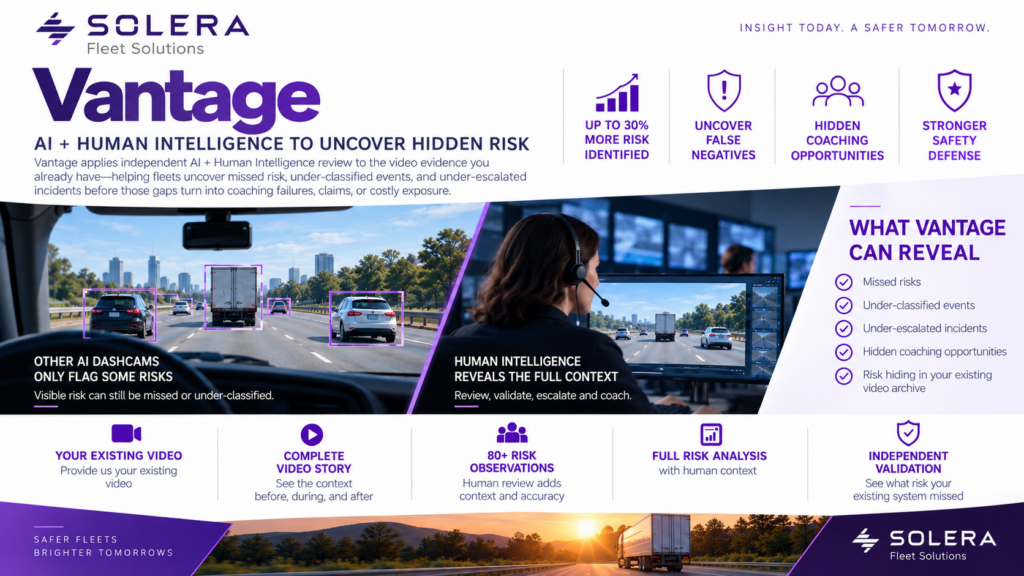
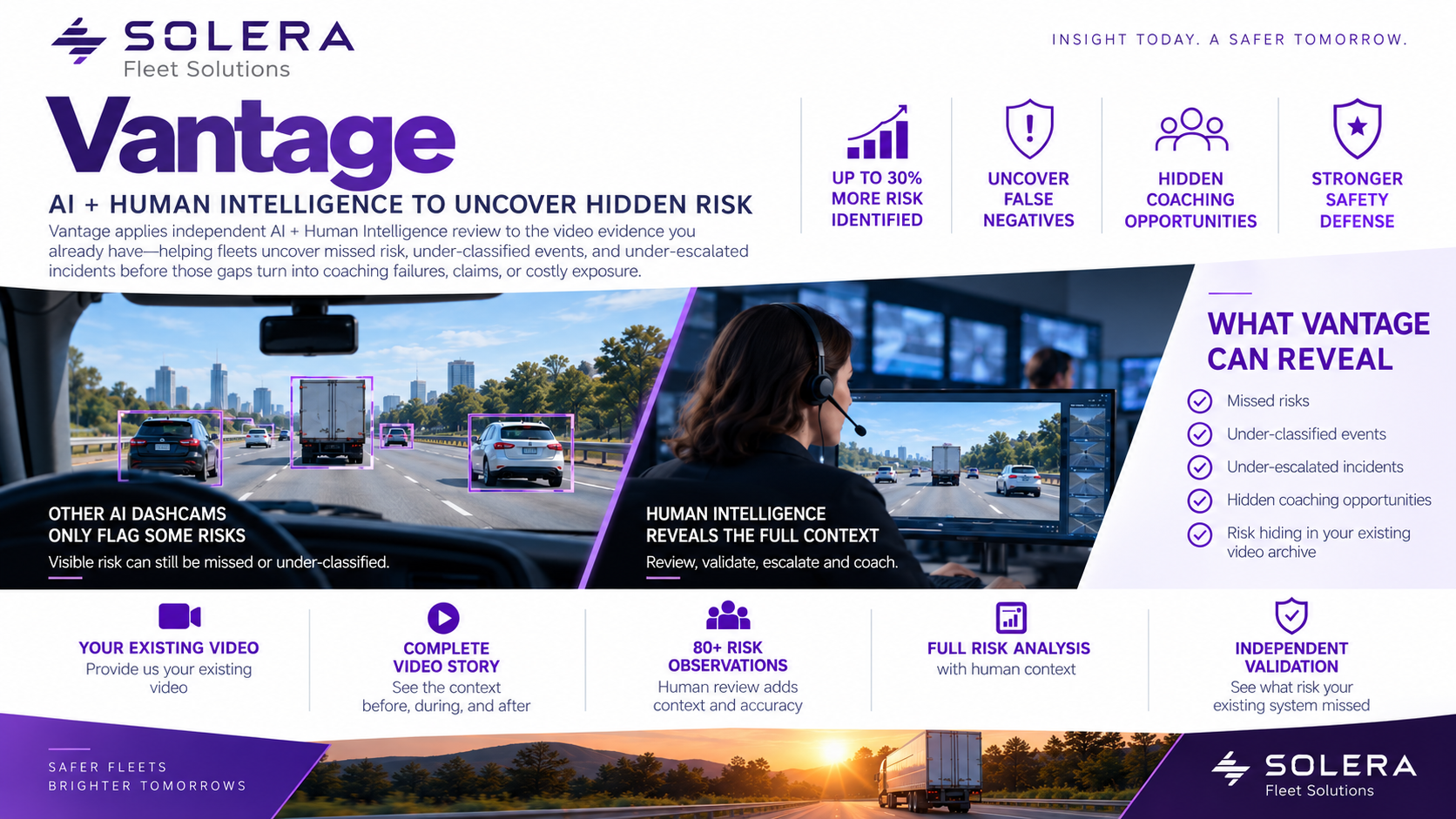
Solera Vantage adds an independent validation layer to the safety evidence you already have. Customers provide existing video, metadata, and provider outputs. Solera applies AI + Human Intelligence review to identify missed, added, under-classified, or under-escalated risk before those gaps are exposed by a claim, audit, or lawsuit.
The result is not another dashboard. It is a clearer view of the risk hiding in your own evidence, the coaching opportunities your process may be missing, and the liability exposure your current provider may never show you.
Audit the Misses Before Someone Else Does
Your greatest exposure may not be the risk your AI detected. It may be the risk still sitting in the same video, waiting for someone else to find it.
A Solera Vantage Hidden Risk Audit can help reveal missed and under-classified risk in the video evidence you already own, before that same evidence is used to challenge your safety program.